Portrait of Samik Bose

Computational Biophysics & Molecular Modeling

Samik Bose

Fixed-Term Assistant Professor

Department of Computational Mathematics, Science & Engineering
Michigan State University · East Lansing, Michigan, USA

bosesami@msu.edu · samikbose20121990@gmail.com

About

Molecular modeling for human health and biology

I am a Fixed-Term Assistant Professor in the Department of Computational Mathematics, Science and Engineering at Michigan State University. Since joining the department in Fall 2024, I have taught several undergraduate and graduate courses, including Computational Medicine, Linear Algebra and Matrix Applications, Machine Learning in Molecular Dynamics, and Independent Research Study. I also continue my postdoctoral research in Computational Biophysics and Pharmacology under the mentorship of Prof. Alex Dickson (Biochemistry and Molecular Biology, MSU).

As an independent faculty member, my goal is to combine the complementary strengths of machine learning and theoretical physical chemistry to develop computational methods for pharmacologically relevant, long-timescale processes — augmenting biomedical and health research through molecular modeling. With my expertise in theoretical chemistry and my interest in drug discovery, I aim to provide a molecular basis for solving critical problems in human health and biology.

To that end, I work to strengthen the synergy between experiment and computation, drawing on facilities such as cryo-EM, NMR, and mass spectrometry. I currently collaborate with experimental scientists across medicinal chemistry (Prof. V. T. Karamyan, Oakland University), cryo-EM and structural biology (Dr. B. J. Orlando, MSU), pharmacology (Dr. K. S. S. Lee, MSU), and biochemistry and structural biology (Prof. A. A. Pioszak, University of Oklahoma Health Sciences Center). These collaborations, at the interface of chemistry, biology, and medicine, continually sharpen my view of the molecular-modeling tools the community needs.

Research

Selected projects

Project 1 · Reactive kinetics

Modeling slow reactive processes — including covalent inhibition — by integrating weighted-ensemble sampling with QM/MM and ML/MM molecular dynamics

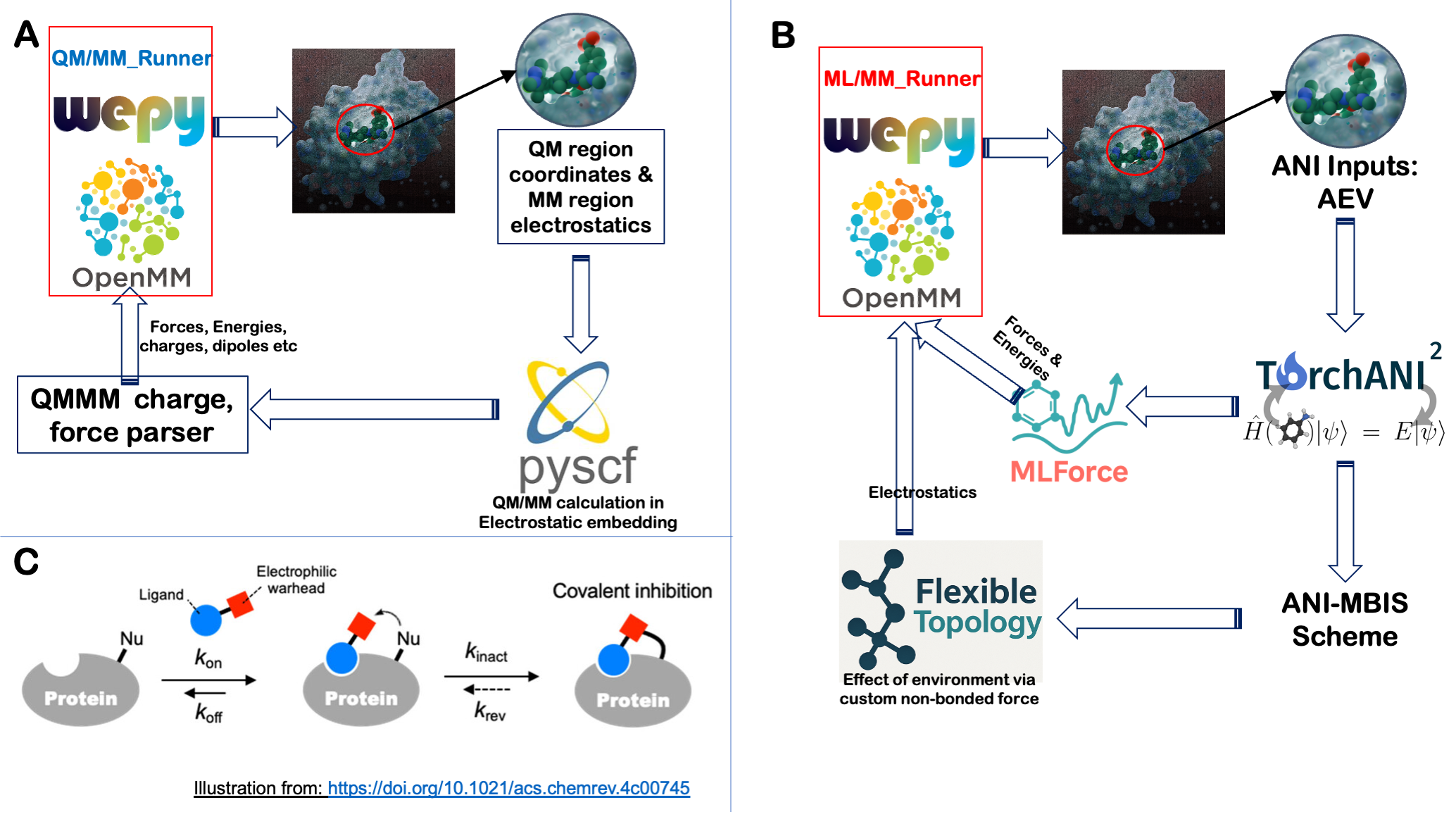
A weighted-ensemble framework (wepy + OpenMM) coupled to first-principles and machine-learning potentials: QM/MM in electrostatic embedding via PySCF, and ML/MM via TorchANI and MLForce with a Flexible Topology treatment of the environment.
Weighted-ensemble QM/MM and ML/MM simulation framework for reactive processes
(A) Weighted-ensemble QM/MM: the QM/MM runner (wepy + OpenMM) passes QM-region coordinates and MM-region electrostatics to PySCF, which performs the QM/MM calculation in electrostatic embedding; forces, energies, charges, and dipoles are parsed back to OpenMM. (B) Weighted-ensemble ML/MM: ANI atomic-environment-vector inputs are evaluated by TorchANI and returned through MLForce, with environmental effects captured via a Flexible Topology custom non-bonded force and ANI-MBIS charges. (C) The covalent-inhibition kinetic scheme (kon, koff, kinact, krev) that motivates direct simulation of the slow reactive step. (Panel C adapted from Chem. Rev. 2024.)
Project 2 · Kinetics

Predicting the kinetics and mechanism of long-timescale biomolecular processes by integrating weighted-ensemble molecular dynamics with Markov state modeling

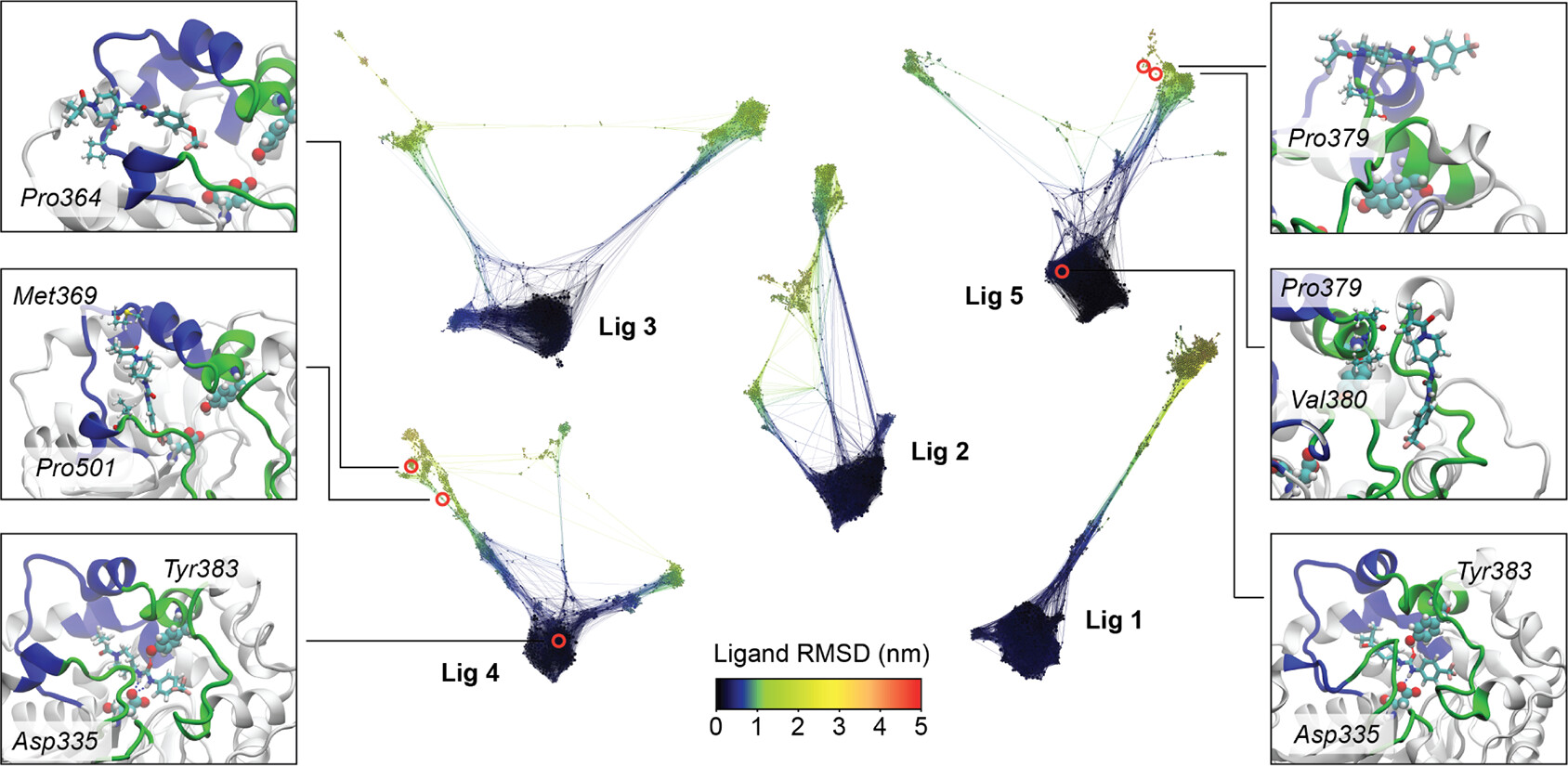
Inhibitor unbinding from soluble epoxide hydrolase (sEH): REVO-enhanced MD projected onto conformational-space networks.
Conformational-space networks of ligand unbinding from soluble epoxide hydrolase
Conformational-space networks (CSNs) of ligand unbinding from sEH on the scale of the ligand RMSD. The networks are arranged and oriented by pathway specificity. Three frames from the most probable unbinding pathways are highlighted for ligand 4 (cavity specificity: left) and ligand 5 (cavity specificity: right), with the corresponding states highlighted in the CSNs. In each panel, the ligands are shown in licorice and the amino-acid residues within 2.5 Å are shown in CPK representation, with binding-site Asp335 and Tyr383 in vdW representation.
Project 3 · Allostery

Decoding the structure and mechanism of allosteric modulators in the Zn-metallopeptidase neurolysin by molecular dynamics and Markov state modeling

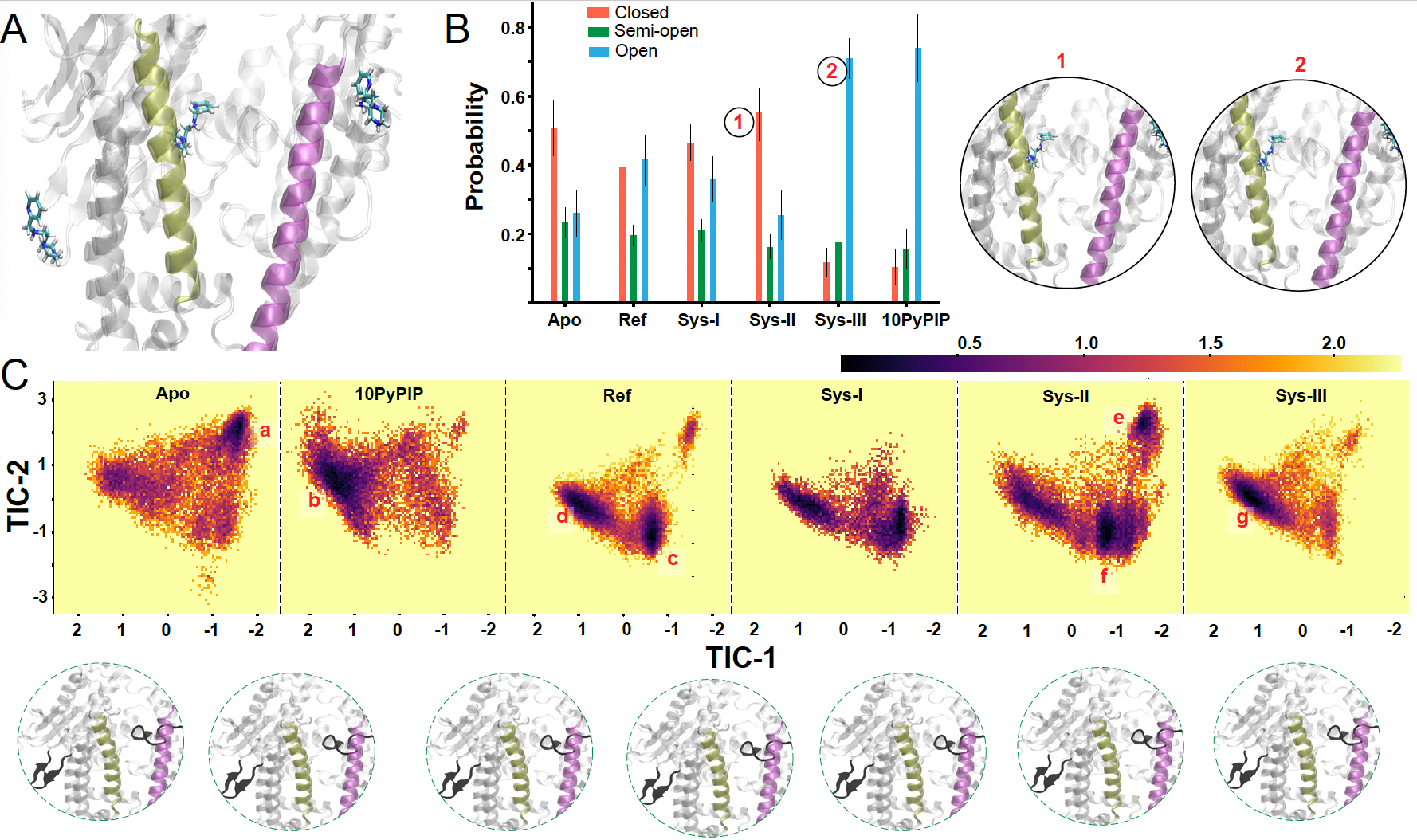
Effect of activator binding across different allosteric sites.
Allosteric modulation of neurolysin across binding sites
(A) The reference starting conformation, where all three binding regions are simultaneously occupied. (B) Probability distribution of Open, Semi-open, and Closed states (red, green, and blue) for apo (crystal), apo (open), System I, System II, System III, and NLN-10Py-Pip; the most probable poses in the closed System II and open System III are shown in the adjacent circles. (C) Free-energy distributions along TIC-1 and TIC-2 for all six systems, with representative NLN conformations in the relevant basins shown below.
Project 4 · ML-driven design

Understanding the chemical attributes of suitable binders in target proteins through machine-learning-driven Flexible Topology simulations

Machine-learning-driven Flexible Topology simulation schematic
Project 5 · Transport

A biophysical basis for molecular transport in transmembrane proteins and GPCRs through molecular modeling and time-lagged dimensionality-reduction approaches

Project 6 · Virtual screening

Virtual screening of inhibitor candidates for soluble epoxide hydrolase by molecular docking

Future aim 1. Improving the efficacy of reversible covalent inhibitors by modeling the slow reactive process through enhanced-sampling QM/MM and ML/MM molecular dynamics.
Future aim 2. Identifying druggable cryptic pockets through directed enhanced-sampling search and ML-guided Flexible Topology scans for allosteric pharmacophore features that bind those pockets.

Keywords: computational chemistry · molecular dynamics · machine learning · enhanced sampling · weighted ensemble · Markov state modeling · QM/MM.

Publications

Selected publications

  1. S. Bose, …, B. J. Orlando. “Structure and conformational dynamics of the transceptor CbrXA and the mechanism of histidine transport.” Protein Science Under review · co-corresponding
  2. S. Bose, A. Aly, V. T. Karamyan, B. J. Orlando, A. Dickson. “Conformation-driven enhancement of neurolysin activity in the presence of a small-molecule activator.” Biophysical Journal Submitted
  3. H. E. L. ElZorkany, H. Kandil, S. Jayaraman, S. H. Esfahani, D. Patel, D. Dannecker, M. Maciag, A. Paul, K. Lowran, S. Bose, D. A. Ostrov, C. G. Wu, A. Dickson, T. J. Abbruscato, P. C. Trippier, B. J. Orlando, V. T. Karamyan. “Discovery of a pyridine-piperazine small molecule that enhances the activity of peptidase neurolysin.” The Journal of Pharmacology and Experimental Therapeutics Submitted
  4. S. Bose, C. Kilinc, A. Dickson. “Markov state models with weighted-ensemble simulation: how to eliminate the trajectory-merging bias.” J. Chem. Theory Comput. 2025, 21 (4), 1805–1816.
  5. S. Bose, S. D. Lotz, I. Deb, M. Schuck, K. S. S. Lee, A. Dickson. “How robust is the ligand-binding transition state?” J. Am. Chem. Soc. 2023, 145, 25318–25331.
  6. N. Donyapour, F. F. Niazi, N. Roussey, S. Bose, A. Dickson. “Flexible Topology: a new method for dynamic drug design.” J. Chem. Theory Comput. 2023, 19, 5088–5098.
  7. S. Bose, S. Chakrabarty, D. Ghosh. “Support-vector-regression-based Monte Carlo simulation of flexible water clusters.” ACS Omega 2020, 5, 7065–7073.
  8. S. Bose, D. Dhawan, S. Nandi, R. R. Sarkar, D. Ghosh. “Machine-learning prediction of interaction energies in rigid water clusters.” Phys. Chem. Chem. Phys. 2018, 20, 22987–22996.
  9. R. Chakraborty, S. Bose, D. Ghosh. “Effect of solvation on the ionization of guanine nucleotide: a hybrid QM/EFP study.” J. Comput. Chem. 2017, 38, 2528–2537. Equal first authorship
  10. S. Bose, D. Ghosh. “An interaction-energy-driven biased sampling technique: a faster route to ionization spectra in the condensed phase.” J. Comput. Chem. 2017, 38, 2248–2257.
  11. S. Bose, S. Chakrabarty, D. Ghosh. “Electrostatic origin of the red solvatochromic shift of DFHBDI in RNA Spinach.” J. Phys. Chem. B 2017, 121, 4790–4798.
  12. S. Bose, S. Chakrabarty, D. Ghosh. “Effect of solvation on electron detachment and excitation energies of a green-fluorescent-protein chromophore variant.” J. Phys. Chem. B 2016, 120, 4410–4420.

Full publication list →

Teaching

Courses at Michigan State University

Computational Medicine

400-level (graduate & undergraduate) · Fall 2024 · Lead instructor — curriculum development.

Linear Algebra and Matrix Applications

300-level undergraduate (3 sections) · Spring & Fall 2025 · Section instructor — team curriculum development.

Machine Learning in Molecular Dynamics

900-level graduate · Spring 2023 · One module (2 lectures, 2 labs).

Independent Research Study

400-level undergraduate · Summer & Fall 2025.

Contact

Get in touch

The best way to reach me is by email at bosesami@msu.edu or samikbose20121990@gmail.com.